





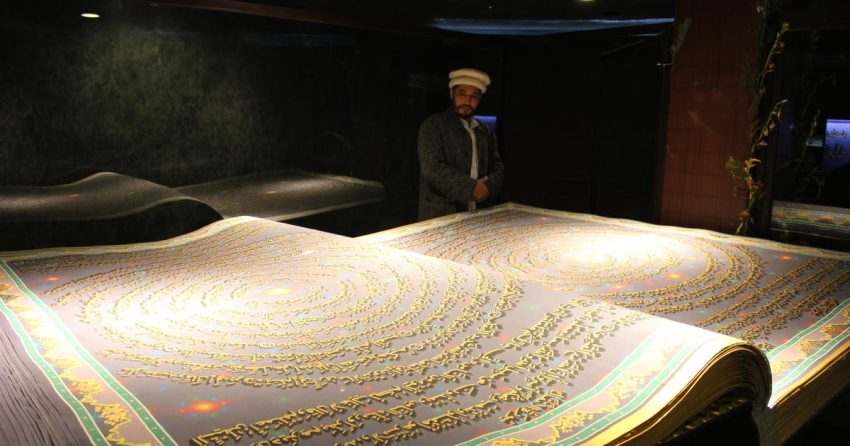
In a remarkable testament to Afghanistan’s rich cultural and Islamic heritage, the world’s largest handmade Quran was unveiled in Kabul in 2012. This extraordinary piece of art was crafted by Afghan calligrapher Mohammed Sabir Khedri Hussani and his team of nine student apprentices over a period of five years. The project was not just an artistic endeavor but also a profound expression of devotion and cultural pride, spearheaded by the Afghan Ismaili leader, Sayed Mansur Naderi.
Overview
The monumental Quran stands over seven feet tall and five feet wide, weighing an impressive 1,102 pounds. It consists of 218 pages, each meticulously inscribed with Quranic verses using the traditional art of Islamic calligraphy. The pages are adorned with intricate designs and decorations, with each of the 30 parts of the Quran featuring a unique design. The entire manuscript is bound in an embossed leather cover crafted from the hides of 21 goats, further adding to its grandeur and significance.
Historical Significance
The creation of this magnificent Quran was initiated in September 2004 and completed in September 2009. However, it was not until January 2012 that the world had the privilege of witnessing its unveiling. The project was deeply rooted in the vision of preserving and promoting Afghanistan’s Islamic scholarship and cultural heritage. Sponsored by Sayed Mansur Naderi, a prominent religious figure and leader of the Shia Ismaili community in Afghanistan, the project symbolizes a blend of faith, art, and national pride.
Sayed Mansur Naderi’s commitment to this project was not just about producing a grand manuscript but also about creating a lasting legacy for future generations. His daughter, Farkhunda Zahra Naderi, played a significant role in the project, particularly in the renovation of the library that now houses this Quran. The manuscript is proudly displayed in the Hakim Nasir Khusraw Balkhi Cultural Center, a facility dedicated to the preservation of Afghan culture and history.
The Inauguration Ceremony
The inauguration ceremony in Kabul was a grand affair, attended by high-level Afghan government officials, religious leaders, and a large public audience. The event also marked the opening of the Hakim Nasir Khusraw Balkhi Cultural Center and an art exhibition showcasing the rich history of Khurasan.
During the ceremony, Sayed Mansur Naderi expressed his deep satisfaction with the completion of the Quran, describing it as a significant achievement not only for Afghanistan but for Muslims worldwide. He emphasized the importance of this work as a contribution to the cultural and religious heritage of Afghanistan.
Mohammad Karim Khalili, the second deputy to then-President Hamid Karzai, conveyed his congratulations, noting that the creation of the world’s largest Quran was a monumental accomplishment for the Afghan nation. Similarly, Afghan Senate House speaker Fazal Hadi Muslimyar presented appreciation letters to Sayed Mansur Naderi, Mohammed Sabir Khedri, and the nine students who contributed to the calligraphy.
The ceremony was also graced by the presence of Hujat ul Islam Waez Zada Besudi, who lauded the initiative as a vital service to the history and culture of Afghanistan. Nematullah Shahrani, an adviser from the Afghan presidential palace and a respected religious cleric, further praised Sayed Mansur Naderi’s efforts in advancing Afghanistan’s cultural and historical services.
Cultural Impact
The unveiling of the world’s largest handmade Quran stands as a testament to the enduring spirit of the Afghan people and their dedication to preserving their religious and cultural heritage. It is a source of immense pride for the Ismaili community and for all Afghans, showcasing their ability to create something truly extraordinary in the face of adversity.
The Quran’s placement in the Hakim Nasir Khusraw Balkhi Cultural Center is part of a broader initiative to safeguard Afghan culture, ensuring that the legacy of this significant work continues to inspire future generations. Through this project, the Ismaili community, under the leadership of Sayed Mansur Naderi, has left an indelible mark on the cultural and religious landscape of Afghanistan, reaffirming their role as key contributors to the preservation of Islamic art and heritage.
The creation of the world’s largest handmade Quran is not merely an artistic achievement; it is a symbol of resilience, faith, and cultural pride that will resonate through history as a shining example of Afghanistan’s rich and diverse heritage.