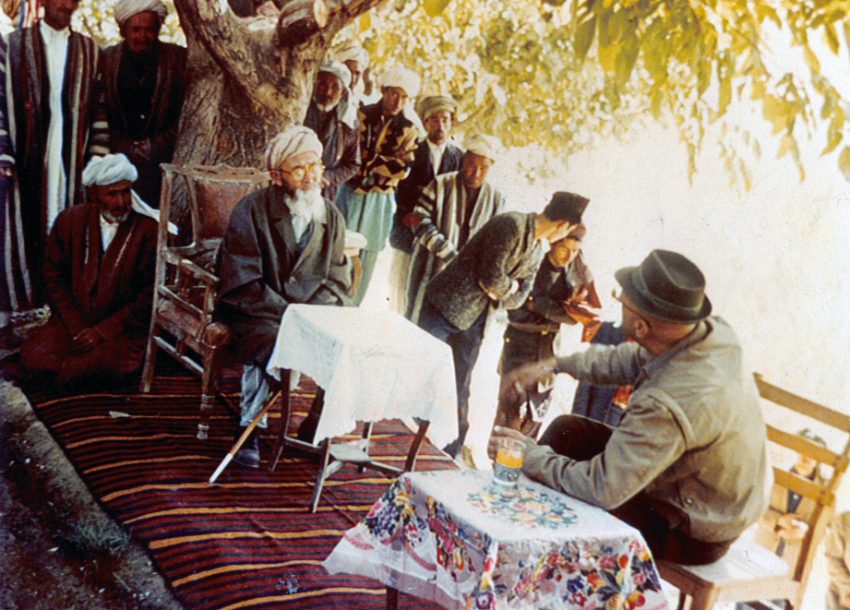
It was a picturesque spring day in 1964 in the valleys of Ashraf and Kayan, where tulips bloomed in abundance, painting the landscape with vibrant colors. The air buzzed with excitement as word spread that His Majesty, King Mohammad Zahir Shah, along with his family, was to visit Kayan Valley. The invitation had come from Sayed Nadir Shah Kayani, known affectionately as “Sayed Kayan.”
The residents of Kayan Valley were filled with anticipation. As the day of the royal visit approached, Sayed Nadir Shah mobilized a large group of men and young people from the Ismaili villages. They were to don their finest clothes and greet the king with the utmost respect, ensuring that his arrival in Kayan was nothing short of spectacular.
On the day of the visit, more than ten thousand people lined the roads leading into the valley, forming a human corridor from the Shikari Valley to Kayan. With the queen accompanying the king, countless women joined the throngs, eager to welcome the royal couple with flowers and applause. For nearly five kilometers, the roads were alive with the sounds of celebration.
As the royal motorcade slowly made its way to a place called “Bandak Valley,” just half a kilometer from Sayed Nadir Shah’s residence, King Zahir Shah was struck by an extraordinary sight. The road ahead had been meticulously covered with the finest carpets, creating a plush path for the royal vehicles. For 500 meters, the luxurious carpets symbolized the deep respect and devotion the people of Kayan felt for their king.
The king and his family were visibly moved by this gesture. It was clear that the people of Kayan Valley held their monarch in the highest regard, seeing him as the “Shadow of God.” The royal car was showered with colorful flowers at various points along the route, and in a traditional act of reverence, several cattle were sacrificed in honor of the king.
The final stretch of the journey was particularly memorable, as the royal motorcade passed over the lavishly carpeted road, where a grand display of flowers awaited them. The king was then escorted to a guesthouse named Gulkhana, where a royal feast had been prepared in his honor. The kitchen of Sayed Nadir Shah Kayani was abuzz with activity as various dishes were served, each more exquisite than the last.
That evening, the women of Kayan Valley gathered around the queen, attending to her needs with sincere devotion. King Zahir Shah, reclining on a cushion, was struck by the order and grandeur of Sayed Nadir Shah Kayani’s court. The experience left a lasting impression on him.
The following day, when it was time for the king to depart, he was once again honored with the same respect and ceremony. Flowers continued to be showered on the royal car for nearly twenty kilometers as men and women lined both sides of the road, bidding farewell to the king. A few thoroughbred horses, gifts from Sayed Nadir Shah, were also led behind the royal car, much to the delight of onlookers.
Inside the car, the king’s son, Prince Ahmad Shah, quietly expressed his amazement at the grandeur and order of the court, noting that it was unlike anything he had seen before. However, the king’s thoughts began to shift. What had initially seemed like a warm display of hospitality now appeared to him as something more—a demonstration of power and status.
Upon returning to Kabul, the king’s security team reported the visit to the then-Prime Minister, Mohammad Hashim Maiwandwal. The Prime Minister echoed the king’s thoughts, suggesting that Sayed Nadir Shah’s invitation was not merely a gesture of hospitality but a calculated display of power.
The king’s advisors were concerned. They argued that there could not be two centers of power in one country—one in Kabul and another in Kayan Valley. They recommended a thorough investigation into the political and economic activities of Sayed Nadir Shah Kayani’s family. The king agreed, and the matter was placed within the legal framework of the time.
From 1967 to 1969, the government intensified scrutiny on the people of Baghlan Province, particularly the Ismaili community. Fabricated documents and baseless accusations were used to exert pressure on Sayed Nadir Shah Kayani and his sons. Sayed Mansoor Naderi, Sayed Rawnaq Naderi, Sayed Gohar Naderi, and Sayed Abdul Qadir Naderi, along with several other respected Ismaili leaders, were imprisoned in Baghlan, Doshi, Jabal Saraj, and Kabul. It was only during the tenure of Prime Minister Noor Ahmad Etemadi that the courts, led by Judge Mr. Forqani, declared the cases against them to be fraudulent and without merit, leading to their release.
What began as an act of sincere hospitality ended in a saga of ungrateful conspiracy, a stark reminder of the complex interplay between power and loyalty.
Source: “Kayanian and Ismailis of Afghanistan” by Sayed Ibrahim Bamyani, published in Kabul, Afghanistan.